Rise Ultra: Atlas Mountains — 60km through Morocco's High Atlas, 8–12 October 2026. Ultra Day is Saturday 10 October.
Distance
60 km
Ascent
2,429 m
Descent
2,430 m
Halfway cut-off
5½ hrs
01 — The day you're training for
Everything in this guide is built backwards from this shape. A loop that starts and finishes at 840m, climbs for the first half, tops out at 1,830m just past 32km, and gives every single metre of it back over the second half.
Drag or hover across the profile — read the distance and height at any point
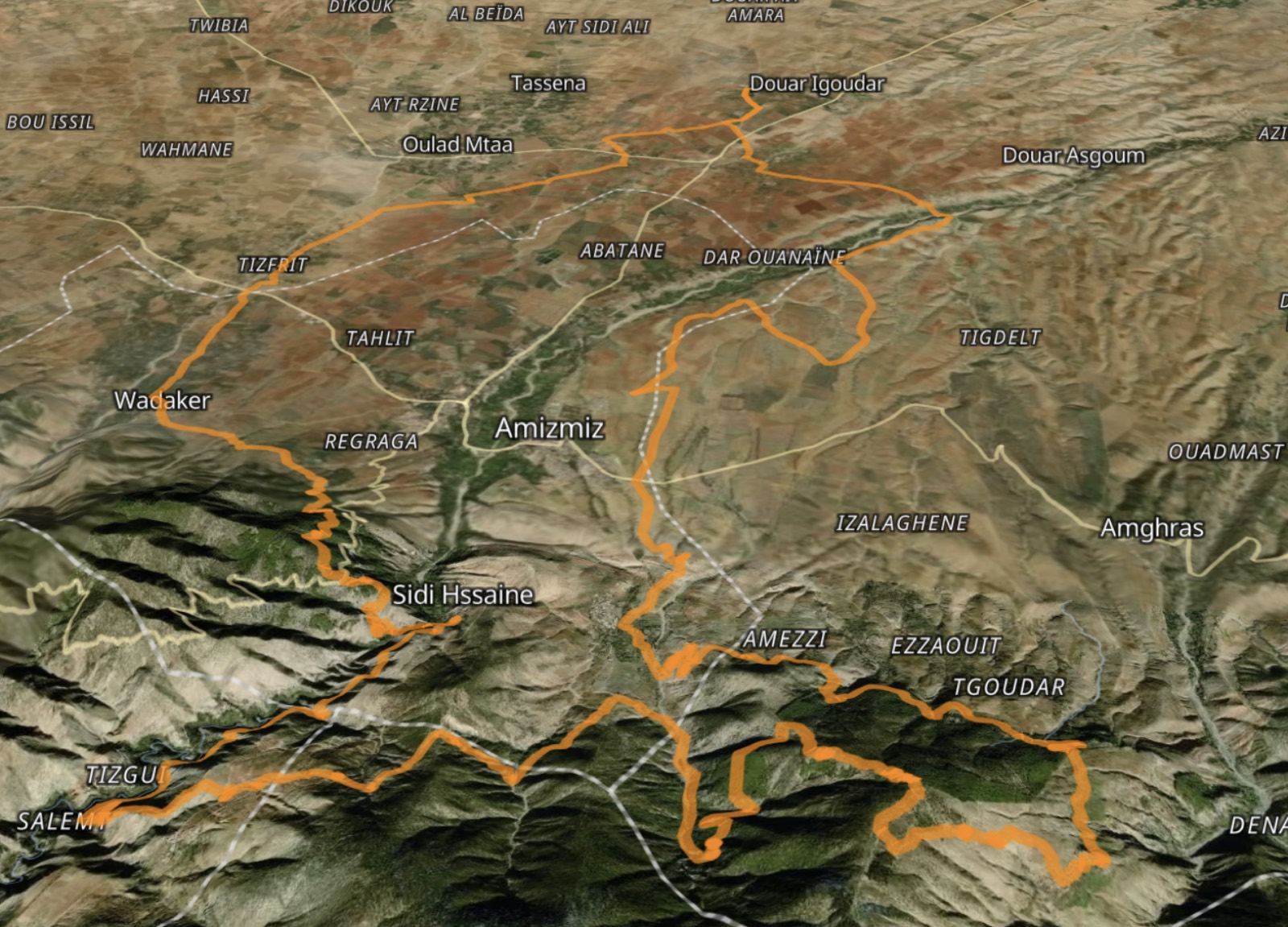
The same loop seen from the south-east. Amizmiz sits in the middle; the course runs out into the hills and comes back to where it started.
Taj Atlas Hotelwhere you're staying — start & finish
CP19km
CP214km
CP316km
CP418km
CP523km
CP627km
CP732.5km
CP835.5km
CP941.5km
CP1048km
CP1154km
Eleven stations, from the 2026 aid station plan. Scrub the profile above and each one names itself as you pass it. Every station that has anything carries the same spread — water, cola, dates, grapes, almonds, peanuts, bananas, oranges and biscuits — with eggs, cheese and potatoes on top at Ait Hamd (23km), Iguer Oulzaz (35.5km) and Tiguenziouin (48km), the three places worth eating properly.
Three carry nothing at all — Talat n’Ihya at 14km, Sidi Hssain at 18km and the summit at 32.5km — so the gaps that matter are between the eight places you can actually refill. The hardest is the 8.5km from Tafegaght at 27km over the summit to Iguer Oulzaz at 35.5km, which is also the steepest part of the day. The longest is the 9km from the start to Tizefrit, though that is the easiest running you will do. Plan your carrying around the gaps, not the dots.
| CP | Distance | Place | What’s there |
|---|---|---|---|
| CP1 | 9 km | Tizefrit | Water, cola, dates, grapes, almonds, peanuts, bananas, oranges, biscuits |
| CP2 | 14 km | Talat n’Ihya | Nothing — carry your own |
| CP3 | 16 km | Azgour Road | Water, cola, dates, grapes, almonds, peanuts, bananas, oranges, biscuits |
| CP4 | 18 km | Sidi Hssain | Nothing — carry your own |
| CP5 | 23 km | Ait Hamd | Water, cola, dates, grapes, almonds, peanuts, bananas, oranges, biscuits + eggs, cheese, potatoes |
| CP6 | 27 km | Tafegaght | Water, cola, dates, grapes, almonds, peanuts, bananas, oranges, biscuits |
| CP7 | 32.5 km | Tanoutfi the peak, ~1,800m | Nothing — carry your own |
| CP8 | 35.5 km | Iguer Oulzaz | Water, cola, dates, grapes, almonds, peanuts, bananas, oranges, biscuits + eggs, cheese, potatoes |
| CP9 | 41.5 km | Tafegaght again | Water, cola, dates, grapes, almonds, peanuts, bananas, oranges, biscuits |
| CP10 | 48 km | Tiguenziouin | Water, cola, dates, grapes, almonds, peanuts, bananas, oranges, biscuits + eggs, cheese, potatoes |
| CP11 | 54 km | Tachbibt | Water, cola, dates, grapes, almonds, peanuts, bananas, oranges, biscuits |
Numbered 1 to 11 in route order. Distances are theirs, rounded to the nearest half kilometre; the elevations shown when you scrub come from the route file. Stations are indicative and not final — treat the two “no food or water” points and the summit as places to arrive already carrying.
Drawn from the actual 2026 route file: 59.7km, 2,429m of ascent and 2,430m of descent, starting and finishing in the same place. Elevation is taken from SRTM terrain data rather than the recording watch’s barometer, sampled every 30m. Other apps may quote a lower climb — elevation gain always depends on how finely you measure, and coarser sampling reports less. Download the GPX to load it into your own watch or planner.
We never end anyone’s day because of their pace. Some checkpoints do have closing times, set with our local mountain team in line with local rules for international runners on remote ridges after dark.
The key one: checkpoint 6 (about 27km) closes at 13:00, 5½ hours after the 07:30 start.
| # | Checkpoint | Distance | Closes |
|---|
The other checkpoint times will be added here before the event.
02 — What the profile actually asks of you
0 – 15 KM
The opening runs low and warm. October in the valley can still sit near 30°C by late morning. This is where almost everyone goes too fast, because it feels easy and the legs are fresh. Going out three minutes per kilometre too quick here costs you an hour later.
15 – 25 KM
Roughly 800m of gain into the high point. Almost nobody runs this — they hike it, and hike it well. Power hiking is a trainable skill with its own rhythm and cadence, not a fallback for when you're tired. If you've never practised it, you'll be slower than people who are fitter than you aren't.
25 – 42 KM
This is the section that ends more first ultras than the climbing does. Around 2,000m of total descent puts enormous eccentric load through the quads. Untrained, they stop absorbing impact somewhere past 30km, and from that point every downhill step hurts. Trained, this is where you make time.
42 – 60 KM
Most runners finish between 7 and 15 hours. The last 18km are run on legs that have already been working for most of a day. Your fitness matters less here than your fuelling, your feet, and whether you've been this tired before.
Checkpoints have closing times, set with our local mountain team so everyone is off the trails before dark. The one to know: halfway, about 27km, within 5½ hours of the start. Miss it and your day does not end — we drive you ahead to a later checkpoint and you run in to the finish with everyone else. Every year the field is a mix of experienced trail runners and people doing their first ultra, and both finish. Train for the profile above and you will get round it.
03 — How the plan works
If you have less than sixteen weeks, that's fine — skip to "Starting late" at the end. The phases matter more than the calendar.
Get consistent. Four to five sessions a week, all of it easy, none of it heroic. The goal is turning up, not getting fit.
Long runs get long, hills get real, and strength work starts to bite. This is the phase that decides your day.
Back-to-back weekends, deliberate downhill work, fuelling rehearsed exactly as you'll do it in Morocco.
Volume drops by roughly half. Intensity stays. You cannot gain fitness now; you can absolutely lose freshness.
04 — Running
You do not need to run 60km before you run 60km. Peak at 32–36km, or four to five hours on your feet, whichever comes first. Beyond that the recovery cost outweighs the benefit for most people.
Better than one enormous run: back-to-back weekends in Phase 3. A three-hour hilly run on Saturday followed by a two-hour run on Sunday teaches your body to work while already tired — which is exactly what 42km onwards asks of it.
Downhill running is a specific adaptation, and it takes six to eight weeks to build. Skip it and your quads will be gone by 35km regardless of how fit you are.
October in the Atlas is cooler at altitude and warm in the valley. If you're training through a European autumn, you'll arrive unacclimatised. Two to three sessions a week in the final fortnight wearing an extra layer, or 15–20 minutes in a sauna after easy runs, gives you most of the benefit. Start hydrating properly two days before you fly, not on the morning.
The high point is just under 1,850m. That's high enough to notice the air is dry, not high enough to affect performance meaningfully. No altitude training required.
05 — Strength
Strength work is not optional on a course with 2,430m of descent. It is the single highest-return hour in your week, and the one most runners quietly drop.
06 — Mindset
Ask anyone who has done this what nearly stopped them, and almost none of them will say fitness.
You will have at least one stretch — usually somewhere between 35 and 45km — where you feel genuinely awful and start doing arithmetic about how much is left. This happens to everyone, including the fast runners ahead of you. It is not a signal that something has gone wrong. Almost every bad patch is fixable with food, water, salt, and twenty quiet minutes. Eat something and keep moving before you make any decisions.
Sixty kilometres is an unhelpful number to hold in your head. Run to the next checkpoint. Then the next. On the long climb, run to the next switchback. The people who struggle most are usually the ones carrying the whole distance at once.
Do some of your long runs in the rain, early, and alone. Do one when you don't feel like it. Every training session where you were uncomfortable and carried on is evidence you'll be able to draw on in October — and evidence is more useful than motivation.
By Ultra Day you'll have already spent a day with the communities your fundraising supports, and you'll pass through that landscape on the route. Most runners say that's what pulled them through the hard hours — not a mantra, just knowing exactly who and what was on the other side of the climb. Don't underestimate how much that changes the day.
If this is your first ultra, you are not an outlier here — you're the norm. The honest requirement is not speed or experience. It's showing up in October having done the long runs, the hills, and the downhills, and being willing to keep walking when running stops being an option. That is genuinely the whole thing.
07 — The sixteen weeks
Long run figures are a guide, not a target. Adjust to your own starting point — the pattern of build, build, build, ease is what matters.
| Week | Long run | Gym | Focus |
|---|---|---|---|
| Phase 1 · Base | |||
| 1 | 90 min | A + B | Establish the weekly rhythm. Both strength sessions in from day one. |
| 2 | 1h 45 | A + B | Add the hill session. Keep everything else easy. |
| 3 | 2h | A + B | First run on proper trail if you can get to it. |
| 4 | 90 min | A + B | Easy week. Volume down by a third. |
| Phase 2 · Build | |||
| 5 | 2h 15 | A + B | Downhill work starts. Keep it short and controlled. |
| 6 | 2h 45 | A + B | Start practising fuelling on the long run. Eat every 30 minutes. |
| 7 | 3h | A + B | Biggest climbing week so far. Aim for 1,500m of ascent. |
| 8 | 2h | A + B | Easy week. Everything drops. |
| 9 | 3h 15 | A + B | Long run in full Ultra Day kit, including the pack. |
| 10 | 3h 45 | A + B | Peak climbing. 2,000m+ of ascent across the week. |
| Phase 3 · Specific | |||
| 11 | 4h + 2h | A + B | First back-to-back weekend. Deliberately hilly. |
| 12 | 2h 30 | A + B | Easy week. Recover properly — this one is earned. |
| 13 | 4h 30 + 2h | A + B | Biggest weekend of the block. Heat prep begins. |
| Phase 4 · Taper | |||
| 14 | 3h | A + B | Volume down a third. Keep one sharp hill session. |
| 15 | 1h 45 | A only | Volume down by half. One strength session only. |
| 16 | 45 min | — | Travel week. Short and easy. Sleep, eat, arrive rested. |
Two sessions, forty minutes each, run in parallel with the table above. They stay the same all the way through — what changes is the load, not the movements. Session A builds the strength that stops your quads failing on the descent; Session B builds the control that stops your form falling apart late in the day.
Session A
Legs, heavy and slow
Session B
Control and durability
Heavy enough that the last two reps are genuinely hard. Never the day before a long run. From week 15 drop to Session A only, and nothing new in the last three weeks. Full detail in Strength.
08 — Fuelling, feet and kit
Carried over from the runner hub so it sits with the rest of your kit planning. Four things are required. Don’t leave the SIM until you land.
Required
Optional
09 — Starting late
Plenty of people join this later than they'd like. It's workable — you just have to be honest about which parts you cut.
10 — Under two months
This is the most common situation on this trip, not the exception. You cannot build sixteen weeks of fitness in eight. What you can do is arrive able to finish, and that is a different training problem with a different answer.
Stop training to run 60km. Train to move for ten to fourteen hours without breaking down. Nobody is racing you, but the halfway checkpoint closes at 5½ hours, so build enough pace to clear it comfortably. A steady walk-run that gets you to the finish is a finish, and it is the same one everyone else gets.
With limited weeks you have to be ruthless. Anything not on this list is optional:
Never cut the taper, however late you started. The instinct with few weeks left is to cram right up to departure. It does not work — fitness gained in the last fortnight is not available to you on the day, but the fatigue is. Arriving fresh and undertrained beats arriving tired and slightly fitter, every time.
If you are inside four weeks, message our founder, Alex, before you plan anything. There is a sensible way to do it, and it is not a compressed version of the sixteen-week plan.
If anything here doesn't fit your situation — an injury, a background that isn't running, a schedule that won't take five sessions a week — message Alex directly. This plan is a starting point, and we'd rather adapt it around you than have you quietly fall off it.
The route GPX is linked in section 01 above. The kit list and the fundraising pack will follow separately.
Message Alex on WhatsApp